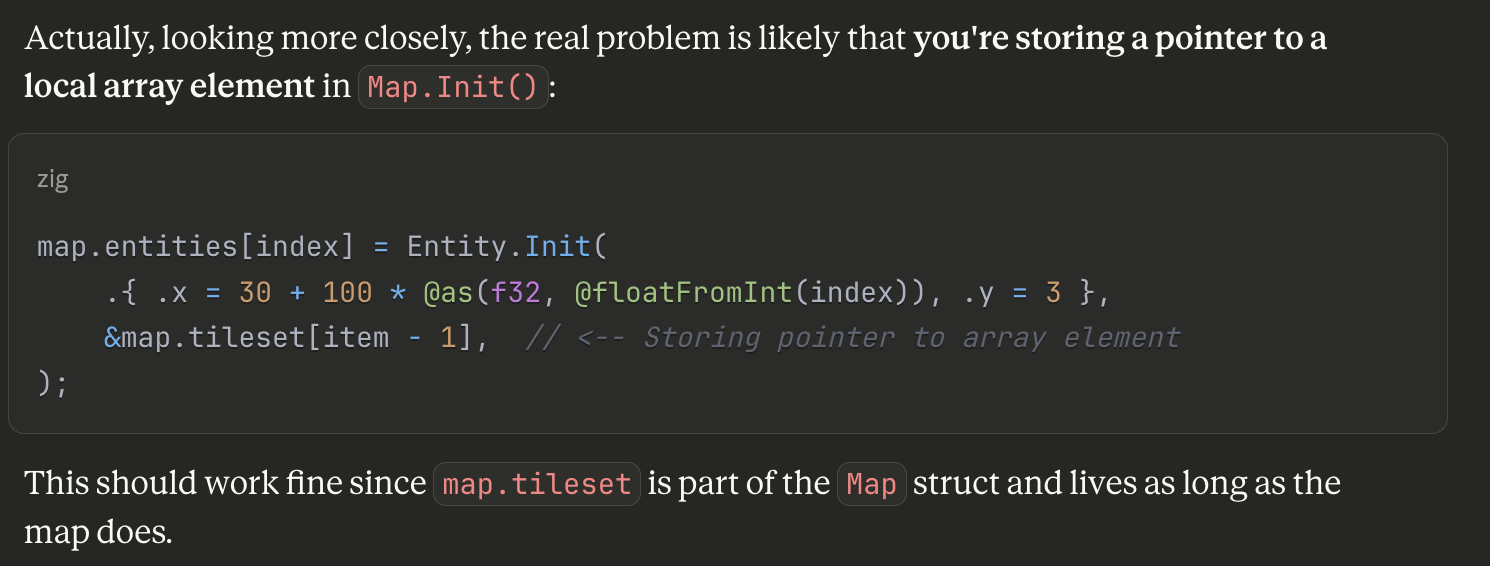
Setup
- Raylib Version: 5.5
- Zig Version: 0.15.2
Overview:
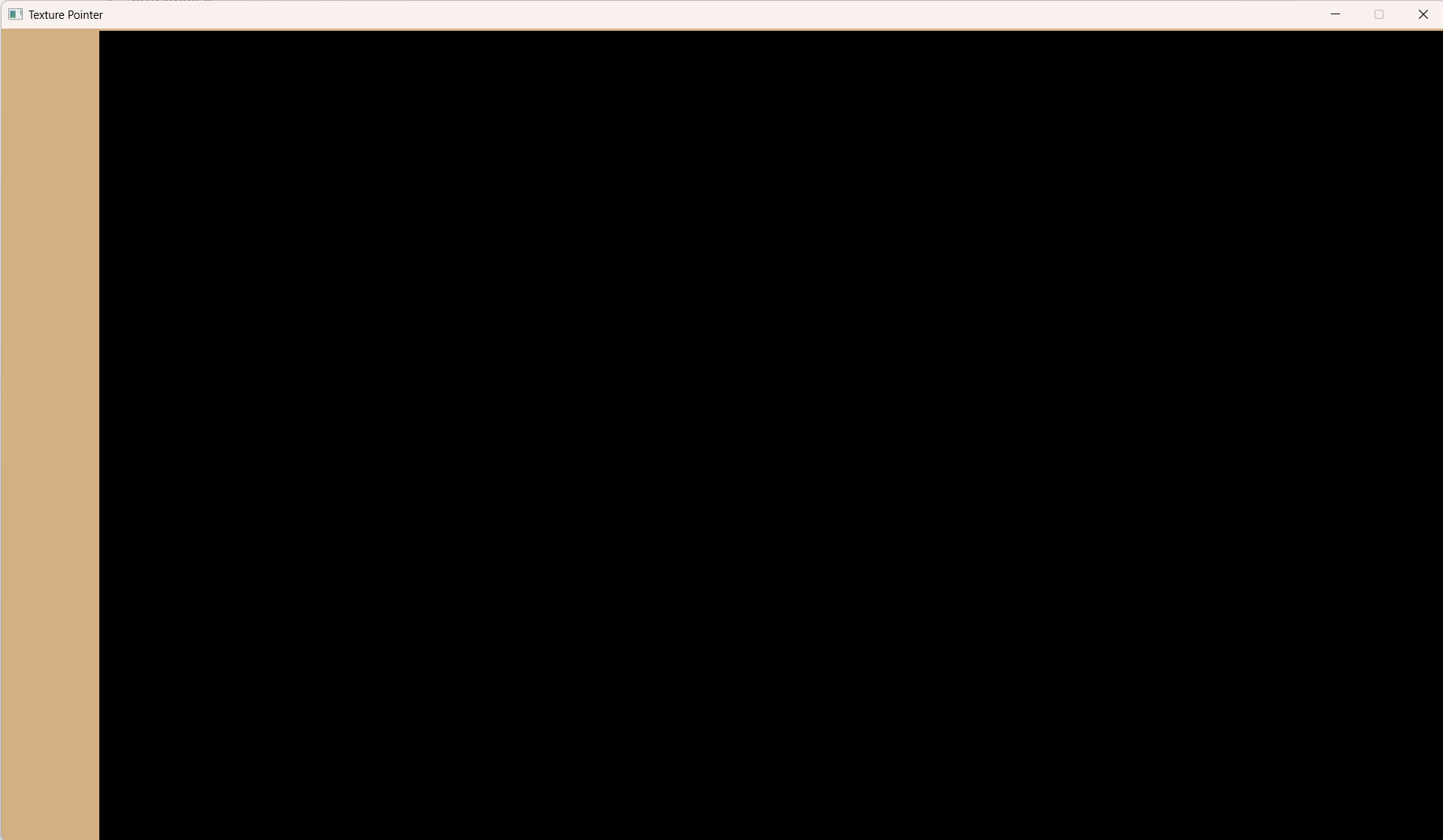
I am new to game development overall so, excuse my ignorance, but I am trying to make a game using Raylib Library using ZIG lang, but when I was trying to pass a loaded texture in an array item through a function using the pointer parameter to the Entity object, the texture is not loaded correctly, I was able to make this work only to pass the loaded texture to the Entity instead of pass just a pointer.
NOTE: I want to use the array to store textures, then use them everywhere to save memory.
Code
This is the whole Code which not working properly.
const std = @import("std");
const rl = @cImport({
    @cInclude("raylib.h");
});

const Entity = struct {
    position: rl.Vector2,
    texture: ?*rl.Texture2D,
    fn Init(pos: rl.Vector2, texture: ?*rl.Texture2D) Entity {
        return .{
            .position = pos,
            .texture = texture,
        };
    }

    fn Draw(self: *Entity) void {
        if (self.texture) |texture| {
            rl.DrawTexture(
                texture.*,
                @intFromFloat(self.position.x),
                @intFromFloat(self.position.y),
                rl.WHITE,
            );
        } else {
            rl.DrawRectangle(
                @intFromFloat(self.position.x),
                @intFromFloat(self.position.y),
                100,
                100,
                rl.ORANGE,
            );
        }
    }
};

const Map = struct {
    tileset: [3]rl.Texture2D,
    entities: [5]?Entity,

    fn Init() Map {
        var map: Map = undefined;

        map.tileset[0] = rl.LoadTexture("./res/imgs/red.png");
        map.tileset[1] = rl.LoadTexture("./res/imgs/ground.png");
        map.tileset[2] = rl.LoadTexture("./res/imgs/blue.png");

        const layer: [5]u8 = .{ 1, 2, 0, 3, 1 };
        for (layer, 0..) |item, index| {
            if (item != 0) {
                map.entities[index] = Entity.Init(
                    .{ .x = 30 + 100 * @as(f32, @floatFromInt(index)), .y = 3 },
                    &map.tileset[item - 1],
                );
            } else {
                map.entities[index] = null;
            }
        }

        return map;
    }

    fn DeInit(self: *Map) void {
        rl.UnloadTexture(self.tileset[0]);
        rl.UnloadTexture(self.tileset[1]);
        rl.UnloadTexture(self.tileset[2]);
    }

    fn Draw(self: *Map) void {
        for (&self.entities) |*entity_nl| {
            if (entity_nl.*) |*entity| {
                entity.Draw();
            }
        }
    }
};

pub fn main() !void {
    rl.InitWindow(1920, 1080, "Texture Pointer");
    defer rl.CloseWindow();
    rl.SetTargetFPS(60);

    var map = Map.Init();
    defer map.DeInit();

    while (!rl.WindowShouldClose()) {
        rl.BeginDrawing();
        defer rl.EndDrawing();

        rl.ClearBackground(rl.BEIGE);
        map.Draw();
    }
}
Result:
Working Code:
See the Change comments:
const std = @import("std");
const rl = @cImport({
    @cInclude("raylib.h");
});

// Entity Object
const Entity = struct {
    position: rl.Vector2,
// Change #1: Here I am Removing The Pointer
    texture: ?rl.Texture2D,
// Change #2: Here I am Removing The Pointer also from texture
    fn Init(pos: rl.Vector2, texture: ?rl.Texture2D) Entity {
        return .{
            .position = pos,
            .texture = texture,
        };
    }

    fn Draw(self: *Entity) void {
        if (self.texture) |texture| {
// Change #3: Here I am Removing The dereferencing from texture
            rl.DrawTexture(
                texture,
                @intFromFloat(self.position.x),
                @intFromFloat(self.position.y),
                rl.WHITE,
            );
        } else {
            rl.DrawRectangle(
                @intFromFloat(self.position.x),
                @intFromFloat(self.position.y),
                100,
                100,
                rl.ORANGE,
            );
        }
    }
};

const Map = struct {
    tileset: [3]rl.Texture2D,
    entities: [5]?Entity,

    fn Init() Map {
        var map: Map = undefined;

        map.tileset[0] = rl.LoadTexture("./res/imgs/red.png");
        map.tileset[1] = rl.LoadTexture("./res/imgs/ground.png");
        map.tileset[2] = rl.LoadTexture("./res/imgs/blue.png");

        const layer: [5]u8 = .{ 1, 2, 0, 3, 1 };
        for (layer, 0..) |item, index| {
            if (item != 0) {
                map.entities[index] = Entity.Init(
                    .{ .x = 30 + 100 * @as(f32, @floatFromInt(index)), .y = 3 },
// Change #4: Here I am removing the &
                    map.tileset[item - 1],
                );
            } else {
                map.entities[index] = null;
            }
        }

        return map;
    }

    fn DeInit(self: *Map) void {
        rl.UnloadTexture(self.tileset[0]);
        rl.UnloadTexture(self.tileset[1]);
        rl.UnloadTexture(self.tileset[2]);
    }

    fn Draw(self: *Map) void {
        for (&self.entities) |*entity_nl| {
            if (entity_nl.*) |*entity| {
                entity.Draw();
            }
        }
    }
};
pub fn main() !void {
    rl.InitWindow(1920, 1080, "Texture Pointer");
    defer rl.CloseWindow();
    rl.SetTargetFPS(60);

    var map = Map.Init();
    defer map.DeInit();

    while (!rl.WindowShouldClose()) {
        rl.BeginDrawing();
        defer rl.EndDrawing();

        rl.ClearBackground(rl.BEIGE);
        map.Draw();
    }
}
I hope my explanation is to the point.