Demo thread! Share screenshots, asciinema recordings, link a blog post you made, or just explain what hobby project you’ve been working on lately.
25 Likes
I’m working on my forever project, xit, which is a git-compatible VCS. I wrote a blog post yesterday about the latest stuff I merged.
37 Likes
I just saw this! I’ve been messing around with git internals lately and so cloned your code locally to have a look around and understand it better.
8 Likes
Still polishing our tiny game Fruits & Tails.
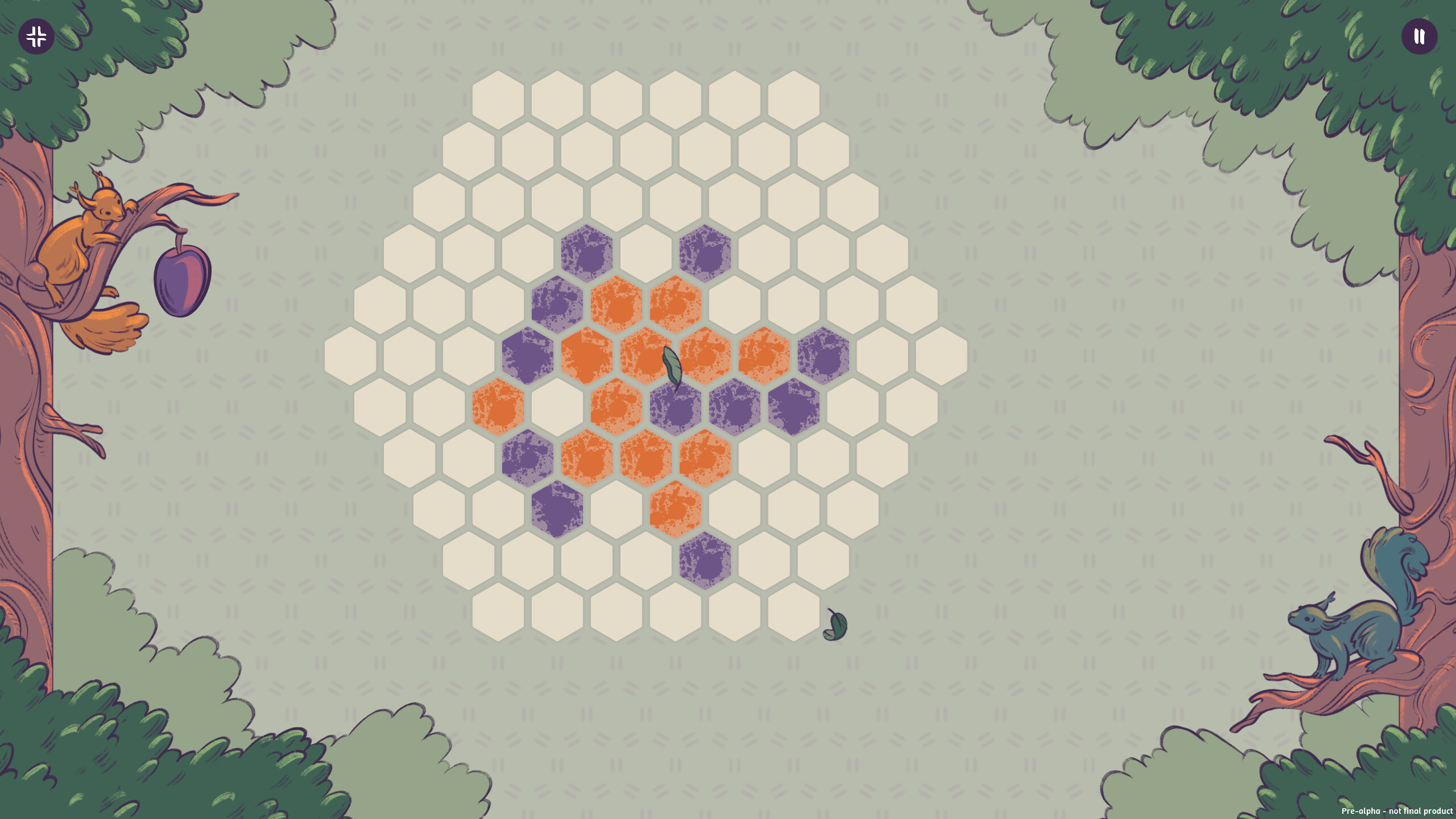
It’s playable in a browser (WASM+Web canvas) and I also got a native version going semi-recently with Raylib. I’ve been trying to package it up for Nix so that I can make a just-enough-OS image for it for showing off at festivals 
I also need to get around to upgrading to Zig 0.16. I imagine it won’t be too much work as it (currently) does very little in terms of I/O.
Edit: Added screenshot
30 Likes
I’ve been porting Awesome WM to Zig and River. Not very far, but it has been a lot of fun. Code is here: https://github.com/Southporter/zany
16 Likes
Still working on a cozy 3d voxel rendering engine/game running entirely* on the cpu and trying out different data structures and rendering algorithms apart from raymarching: https://youtu.be/y0xlGATGlpA


Also working on some videos and maybe some written, technical posts going into detail on how this thing works architecturally, and zig is still so much fun to write this project in.
*The engine is just concerned with rendering a final framebuffer, which is all done on the cpu. The implementer can decide what to do with that and how to display it.
Apart from that, I also experimented with running zig on an esp32-s3 with a display, creating a small companion necklace that just looks around while wearing it and has different facial expressions etc.
That one also was fun, writing a 2d SDF renderer / rasterizer running on the esp32 with which i can just programmatically drive shapes, lines, and the face after all.

56 Likes
I was filling my free time porting harfbuzz rustybuzz to zig. I stopped for a while because StS2 happened then other things. I will get back to it soonishto upgrade it to 0.16.0 and continue
currently i am just messing around with 3sl to add some features I’d like to see.
6 Likes
Nothing to show yet. I’m working on a succinct data structure library for Zig; so far the benchmark number looks promising.
6 Likes
I’m rewriting my game engine in Zig (Zig code not yet public) as a way to learn the language and decide whether to switch over to it fully. I appreciated seeing the “This is part of a larger effort to improve ergonomics for making video games in Zig.” changes in the 0.16 notes and hope to be able to provide feedback about the language for games.
14 Likes
Im looking forward to test zig newest Io interface in backend of my aplication for People with Cohearent Implants to achieve the low latency necessary for real-time auditory processing but we will see
if anyone built anything for transcription STT or any similar software in zig im happy to hear from you
4 Likes
Goat, I was learning zig on your project!
1 Like
Tennis table viewer! Ported to 0.16 last night, sitting on a release that also includes windows support and some feature requests. Trying to decide if my 0.16 support should use a global App struct or just pass alloc/io/env everywhere…
Codex really helped with the upgrade. It was a little befuddled by io, it made everything work but needed stylistic guidance. Little things like the switch from trimLeft/Right => trimStart/End confused it as well. FYI codex can one shot things like “upgrade deps to 0.16 and vendor if necessary”

14 Likes
Syntax-directed diffing.
15 Likes
A for-profit keyboard based calorie tracker I am waging my life on.
4 Likes
2 years effort (full-time last 8 months) into a microkernel/OS for the PinePhone. 10k Zig LoC, with some global assembly. Just about completed the UI, navigation, and various sensors. Next will be the beeps  and then some apps (maybe a games SDK if I can access OpenGL ES).
Zig has been an amazing fit for this project, the code is easy on the eyes, the binary tiny, and the whole thing is booting into a pair of demo apps in under 800ms! and that is still only using 1 of the 4 cores.
Sorry to say I’ll be sticking with older Zig version. It seems a better fit, and I’m not keen on the new IoC/DI design direction that Zig has now taken. But thanks for the amazing journey from 0.7, and wishing you the best of luck.
And a huge thank-you for the community that is so professional, welcoming and supportive. This OS might be my final tech project, since AI is destroying much of what I love about the industry, but glad that there is some kinda sane refuge here. I love reading all the projects that everyone is working on, and amazes me still how inventive we can be when working together.
31 Likes
I posted recently about my RE2 style (Go regexp, Rust regex) regex engine.
Aspire to be the go to regex package for Zig!
8 Likes
No judgement whatsoever, but I’m curious, do the I/O changes even affect your project at all? If you’re targeting freestanding, I would expect that you didn’t use std lib file system, networking, threads, etc. So I would expect those changes to you to be like a storm in a different city than you live in.
6 Likes
Currently working on an NES emulator.
My knowledge of how this technology actually works on the hardware level was very rudimentary, so I decided to jump into a project that would provide some experience with it as a learning exercise, even if it is simplistic by modern standards.
12 Likes
I’m building a Google Maps alternative specifically for Portland, OR.
Google Maps simply can’t implement many features because they are targeting the entire world and expect massive load. Scale down the area and population to a metro area and many things are suddenly feasible. For example: finding ADA accessible routes, or multi-modal trips where you bike partway and take your bike onto the MAX for the rest, or flagging that you’re currently on a bus and need to know the best connection to make.
Still in the “write throwaway code → research → understand → repeat” loop, so nothing to show yet. The geospatial domain is massive. Huge props to the OpenStreetMap folks and adjacent projects. The goal is to get something small working for PDX, get increasing #s of friends and beta users to daily drive, then open it up publicly once it seems stable. Assuming people choose to use it, I’ll try to spin out as many pieces as possible as libraries so other cities can build their own. Ghostty’s path has been super inspirational, and while it’s waaaay too early to plan for that kind of success, it seems like a great way to improve people’s lives while helping others build essential infrastructure in their own cities.
EDIT: In honor of the spirit of a showcase, here’s our city’s public transit moving around in real time thanks to Trimet’s public GTFS feed showing location:

37 Likes
I’m working zitrus a fully independent Nintendo 3DS SDK, still going strong since I started it. I initially wanted to see how difficult it would be to run homebrew with only zig from scratch and I got very nerd-sniped.
I’ve been tackling Io and a graphics api for quite some time and I plan to start looking into audio, a libc and implementing async/concurrent after I finish with it. Everything needed to make a game (except audio) is implemented so far.
There’s still a lot of things to do. It never ends! 
26 Likes