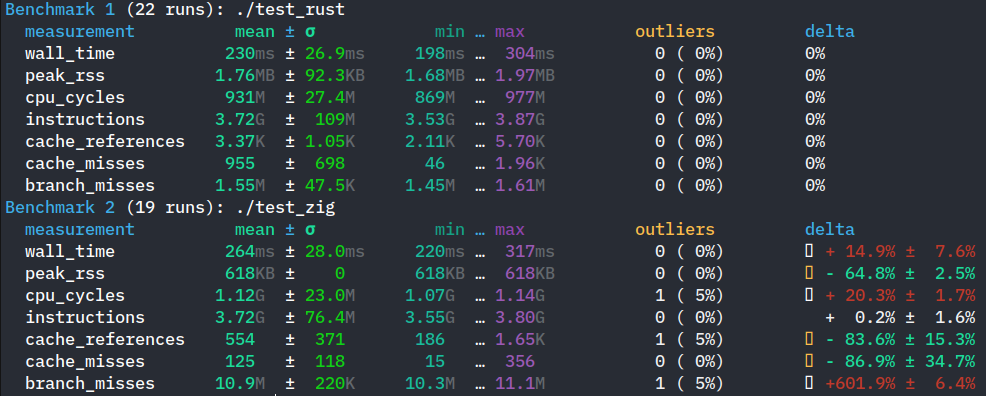
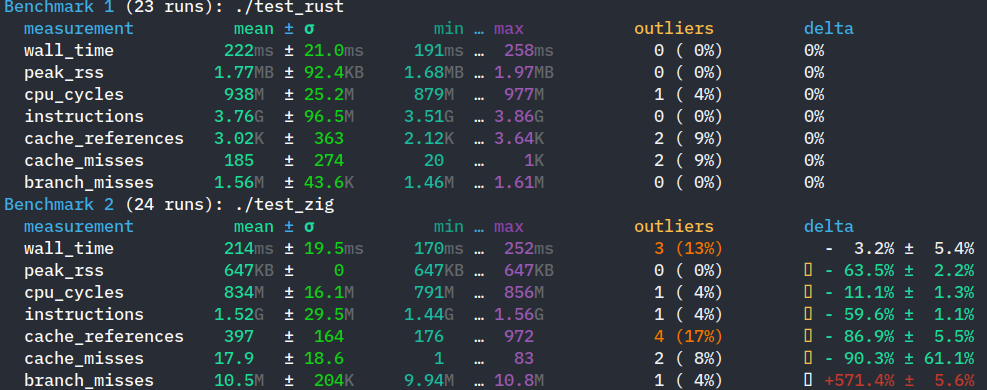
Hi yall! I want to start off by saying that I really like the zig project and it’s goal for making the language simple and explicit.
Very recently I have taken a liking to low level programming (Though I never dipped my toes), and I started following rust and zig’s development. But today I decided to dive in for a couple hours and see what it’s like.
After I did a couple of exercises here and there in both rust and zig I accidentally made a little benchmark of sorts.
Now before I continue, I’m fairly confident that I’m doing something sub-optimal in my implementation which is why I decided to post, and I’m pretty sure these comparisons with other languages (especially rust) are mostly not productive, but this is just my curiosity coupled with my ignorance in the field coming together.
I decided to make a simple password generator that randomly picks elements from an array that contains some ASCII characters, and each password is 32 characters long, And for some odd reason I decided to loop that entire process 1 million times, include a simple math op in the hot loop just for giggles and pipe the output into a file.
Here is that code in zig:
const std = @import("std");
const Random = std.Random;
const out = std.io.getStdOut();
pub fn main() !void {
    var stdout_buffer: [256]u8 = undefined;
    var stdout_writer = std.fs.File.stdout().writer(&stdout_buffer);
    const stdout = &stdout_writer.interface;
    const SOME_ASCII = [_]u8{
        'a', 'b', 'c', 'd', 'e', 'f', 'g', 'h', 'i', 'j', 'k', 'l', 'm', 'n', 'o', 'p', 'q', 'r',
        's', 't', 'u', 'v', 'w', 'x', 'y', 'z', 'A', 'B', 'C', 'D', 'E', 'F', 'G', 'H', 'I', 'J',
        'K', 'L', 'M', 'N', 'O', 'P', 'Q', 'R', 'S', 'T', 'U', 'V', 'W', 'X', 'Y', 'Z', '1', '2',
        '3', '4', '5', '6', '7', '8', '9', '!', '?', '/', '_', '#'
    };
    var seed: u64 = undefined;
    try std.posix.getrandom(std.mem.asBytes(&seed));
    var prng = Random.DefaultPrng.init(seed);
    const random = prng.random();
    var y: u64 = 0;
    for (0..1000000) |i| {
        if ((i / 4) == 0) {
            y = i % 13;
        }
        for (0..32) |_| {
            try stdout.print("{c}", .{SOME_ASCII[random.intRangeAtMost(u8, 0, 65)]});
        }
        try stdout.print("\n", .{});
    }
    try stdout.flush();
}
And here is the closest implementation that I was able to make in rust:
use std::io::{self, BufWriter, Write};
fn main() {
    const SOME_ASCII: [char; 66] = [
        'a', 'b', 'c', 'd', 'e', 'f', 'g', 'h', 'i', 'j', 'k', 'l', 'm', 'n', 'o', 'p', 'q', 'r',
        's', 't', 'u', 'v', 'w', 'x', 'y', 'z', 'A', 'B', 'C', 'D', 'E', 'F', 'G', 'H', 'I', 'J',
        'K', 'L', 'M', 'N', 'O', 'P', 'Q', 'R', 'S', 'T', 'U', 'V', 'W', 'X', 'Y', 'Z', '1', '2',
        '3', '4', '5', '6', '7', '8', '9', '!', '?', '/', '_', '#',
    ];
    let mut _y: u64 = 0;
    let stdout = io::stdout();
    let mut handle = BufWriter::new(stdout.lock());
    for i in 0..1000000 {
        if (i / 4) == 0 {
            _y = i % 13;
        }
        for _ in 0..=32 {
            write!(handle, "{}", SOME_ASCII[rand::random_range(0..=65)]).unwrap();
        }
        write!(handle, "\n").unwrap();
    }
}
Now, to figure out which implementation was faster, I initially used valgrind’s cachegrind to see cache misses (since I read that they were very expensive) as well as branch mispredictions like so:
valgrind --tool=cachegrind --cache-sim=yes --branch-sim=yes ./test -> out.txt
(To clarify, for zig I used version 0.15.2 with the ReleaseFast build flag, and for rust the default release profile)
With those metrics alone, zig was the clear winner from what I could tell, here are zig’s results following the valgrind command:
==6498==
==6498== I refs:        3,877,780,541
==6498== I1  misses:               53
==6498== LLi misses:               53
==6498== I1  miss rate:          0.00%
==6498== LLi miss rate:          0.00%
==6498==
==6498== D refs:        1,096,000,207  (632,000,153 rd   + 464,000,054 wr)
==6498== D1  misses:               41  (         29 rd   +          12 wr)
==6498== LLd misses:               41  (         29 rd   +          12 wr)
==6498== D1  miss rate:           0.0% (        0.0%     +         0.0%  )
==6498== LLd miss rate:           0.0% (        0.0%     +         0.0%  )
==6498==
==6498== LL refs:                  94  (         82 rd   +          12 wr)
==6498== LL misses:                94  (         82 rd   +          12 wr)
==6498== LL miss rate:            0.0% (        0.0%     +         0.0%  )
==6498==
==6498== Branches:        375,376,641  (372,376,640 cond +   3,000,001 ind)
==6498== Mispredicts:      12,164,014  ( 12,164,010 cond +           4 ind)
and here are rust’s results using that same command:
==6816== I refs:        3,804,788,630
==6816== I1  misses:            1,898
==6816== LLi misses:            1,799
==6816== I1  miss rate:          0.00%
==6816== LLi miss rate:          0.00%
==6816==
==6816== D refs:        1,439,370,448  (869,316,334 rd   + 570,054,114 wr)
==6816== D1  misses:            2,841  (      2,120 rd   +         721 wr)
==6816== LLd misses:            2,364  (      1,690 rd   +         674 wr)
==6816== D1  miss rate:           0.0% (        0.0%     +         0.0%  )
==6816== LLd miss rate:           0.0% (        0.0%     +         0.0%  )
==6816==
==6816== LL refs:               4,739  (      4,018 rd   +         721 wr)
==6816== LL misses:             4,163  (      3,489 rd   +         674 wr)
==6816== LL miss rate:            0.0% (        0.0%     +         0.0%  )
==6816==
==6816== Branches:        665,970,699  (599,955,262 cond +  66,015,437 ind)
==6816== Mispredicts:       1,549,783  (  1,549,413 cond +         370 ind)
==6816== Mispred rate:            0.2% (        0.3%     +         0.0%   )
So with these results in mind, I assumed that when I measure the time of execution of each implementation, zig would be much faster, but I was almost surprised to see that the rust executable was almost consistently 80 to a 100ms faster on my machine, here is a sample output:
zig:
time ./test -> output.txt

real	0m0.364s
user	0m0.276s
sys	0m0.087s
rust:
time ./target/release/test -> output.txt

real	0m0.267s
user	0m0.226s
sys	0m0.027s
Now I ran those measurements multiple times under similar conditions and the difference was consistent which made me feel like this wasn’t a within a margin of error type of situation.
So to try to make even a little sense of where this difference was coming from, I decided to use KCachegrind with the hope that beautiful graphs, shapes and colors would help me understand something (It didn’t).
To get those visualizations I used the callgrind tool from valgrind for KCachegrind to consume, here is that command:
valgrind --tool=callgrind --cache-sim=yes --branch-sim=yes ./test -> out.txt
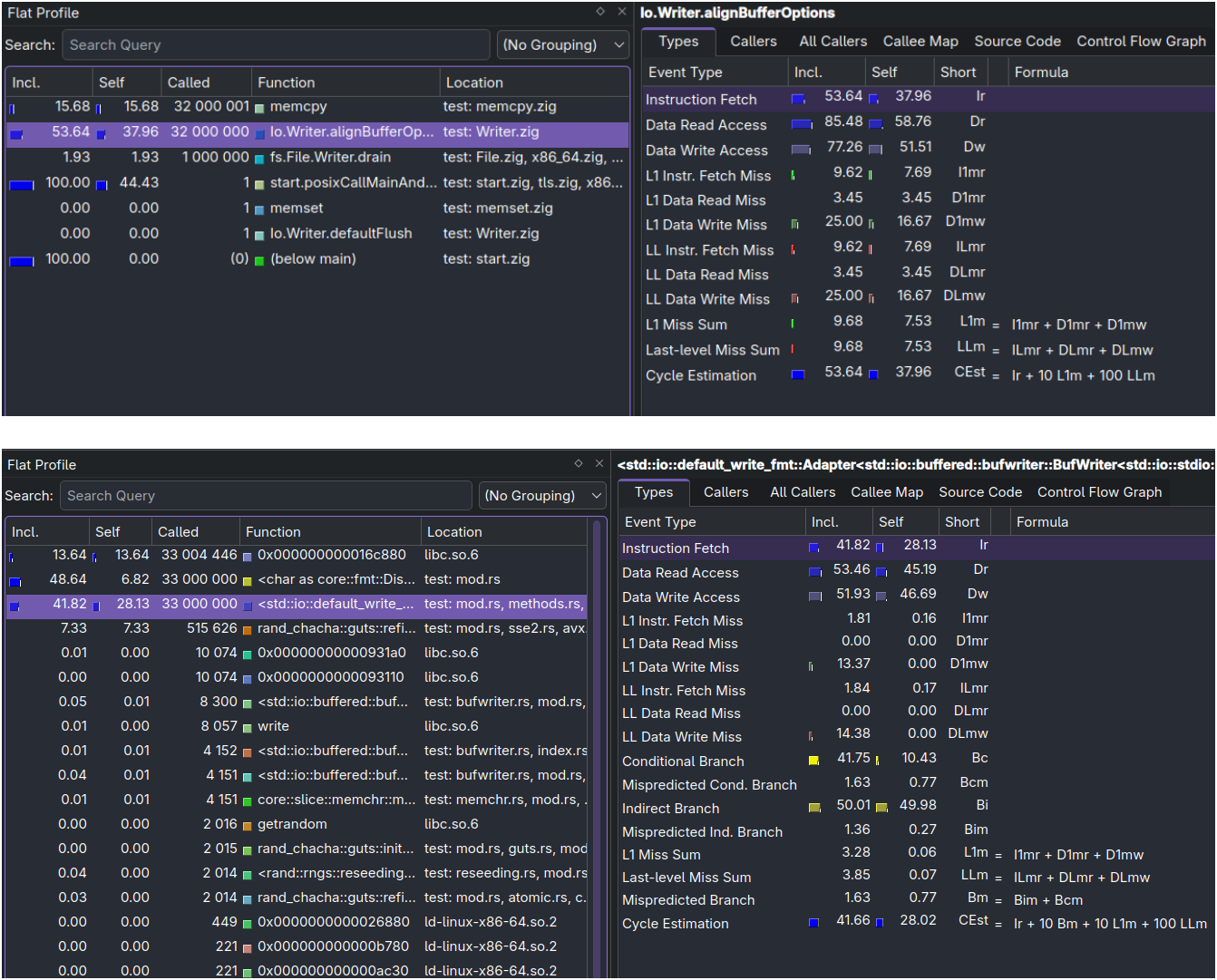
The upper image is zig’s binary visualization, while the bottom one is rust’s.
For the sake of not having to merge too many screenshots, I focused on 2 functions, the Io.Writer.alignBufferOptions in the zig screenshot since I believe It’s the subject of interest here and I focused and the std::io::default_write_fmt function in rust’s screenshot since I assumed that it maybe serves the same purpose as the Io.Writer.alignBufferOptions function in zig’s output, though I could be wrong.
Now this is where I reached my limits of understanding what could be going on, other than the weird fact that There are 33 million calls to 3 functions in rust in comparison to 2 functions getting called 32 million times as one would expect (Maybe somehow the newline character that I insert after every line counts here?)
The thing that stood out to me is in the event types “Instruction Fetch” , “Data Read Access” and “Data Write Access” which I would assume to be the main pieces here, zig has a lot more number of instructions generated by those types than rust, like Data Write Access: 77.26k as opposed to rust’s Data Write Access: 51.23k etc…
I don’t know if those numbers indicate that rust might have a more optimized implementation or if I’m at fault, but whatever it might be, rust seems to have an edge in execution time.
I would love for someone to explain if there is something different that I can do to reach or exceeds the IO throughput in comparison to rust’s, I would love for this to be a mistake on my part rather than a slightly less optimized implementation in zig’s std library, but hey, if by any chance I helped uncover a potential area of improvement, then I’m also contented.
Thank you to whoever takes the time to take a look at this and thank you to the zig team for your efforts! can’t wait to play around with zig even more in the coming days!